Aku Akan Bertahan / I Will Survive

welcome_Aku-Akan-Bertahan_I-Will-SurviveAku Akan Bertahan / I Will Survive

3 channel HDvideo installation, approx 27mins loop (27:29mins 27:33mins 26:49mins)

Series of 6 Archival Pigment Prints (120x80cm)
2015

video preview with reference clips from the original films


Aku Akan Bertahan / I Will Survive comprises a three-channel video installation, a photoseries and a live dance performance.
Using 3 classics of Australian cinema as a starting point – Picnic at Hanging Rock (Peter Weir, 1975); Walkabout (1971, Nicholas Roeg); Priscilla Queen of the Desert (1994, Stephan Elliot) – 3 films that deal with the confrontation of humans with the Australian outback – Aku Akan Bertahan / I Will Survive transposes the characters, narrative, and location to Jogjakarta in Java, Indonesia, situated between Singapore (where the artist comes from) and Brisbane (where the work was finally presented). By transposing the imaginary from the Australian films to Java, Indonesia – notable for its long history and religious evolution that intersects Buddhism, Hinduism and Islam – the work taps into a larger, older, shared regional history – far older than notions of colonial Australia or Singapore.

For Aku Akan Bertahan / I Will Survive the Singaporean Chinese artist invited 3 other collaborators who also work with Drag: Tamara Pertamina (Indonesian based in Jogja); Shahmen Suku (Indian Singaporean based in Sydney); and Bradd Edwards (Caucasian Australian based in Sydney).
During a 2-week residency in Jogja, they learnt a choreography that combines classical Javanese dance, Dangdut (Indonesian Pop) and hiphop (with a nod to Beyoncé Knowles), set to Gloria Gaynor’s anthem I Will Survive (immortalised in the film Priscilla) in a new version devised with an Indonesian Street band of “Angklung” musicians improvising on their bamboo instruments.
The four performers can be seen as Victorian schoolgirls wandering amongst ancient volcanic rocks, or as nymphs bathing in mystical waters, or as decorated (drag)queens conquering the mountains overlooking the lands. Crowned with wigs made of recycled plastic raffia in bold primary colours, the four figures are a mix of Javanese decoration, drag queen kitsch, children’s television, classical European painting, Cosplay, etc – blurring the lines of ethnic or national belongings, and between high and low culture. What does survive is the determinedness of the indeterminacy of culture, a resolution to perpetual (r)evolution.

Performers Ming Wong, Tamara Pertamina, Shahmen Suku, Bradd Edwards
Choreographer Otniel Tasman
Production Manager Karina Roosvita
Production Assistant Tamara Pertamina
Location scout Ardi Kuhn
Cinematogapher Shalahuddin Siregar
Stills photographer Christian Dwiky
Make-up & Hair Gandrik Waluyo
Music (Part 3) Orkes Angklung New Banesa
Music recording Andreas Oki Gembus
Postproduction Kin Chui, Marko Schiefelbein

Filmed on location in Jogjakarta, Indonesia.

Commissioned for the 8th Asia Pacific Triennial of Contemporary Art (APT8) by Queensland Art Gallery / Gallery of Modern Art (QAGOMA), Brisbane, Australia in 2015.
With support from Artspace, Sydney and National Arts Council, Singapore.

With thanks to:
Arahmaiani Feisal, Deddy Irianto (Langgeng Art Foundation), Jimmy Ong, Mulyana, Russell Storer
blouinartinfo interview

Ascent to the Heavenly Palace (I-IV) / 飞向天宫

Ascent to the Heavenly Palace (I-IV) / 飞向天宫
2015, Photographic series, 110x165cm


Looking At The Stars / 仰望星空

LATS02
Looking At The Stars / 仰望星空


live performance commissioned for Mobile M+: Live Art, Hong Kong 2015

video preview

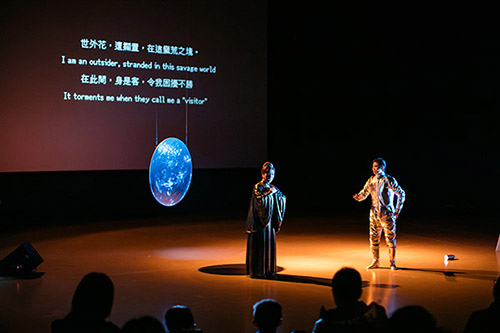
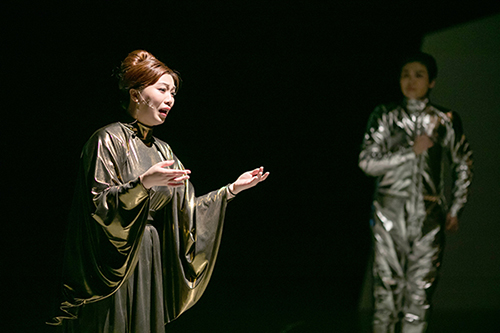
“Ming Wong’s live performance Looking at the Stars is a key chapter in his ongoing research into the seemingly opposite realms of traditional Cantonese opera and science fiction. Exploring the meeting of cinema, theatre, gender representation, and the intricate dance between language and translation, the performance draws inspiration from Andrei Tarkovsky’s genre-bending cinematic classic Solaris (1972) to tell a new kind of story. It also serves as an experimental exploration that will inform Wong’s staging of a full-fledged sci-fi influenced Cantonese opera production in the near future.

LATS01

Looking at the Stars is a collaborative effort developed through workshops between Wong and young Cantonese opera actors and musicians. The resulting collection of gestures, images, and specially-written Cantonese opera passages – performed by female actors as a nod to traditional cross-gender roles – are staged with the atmospheric intensity of the deserted space station in Solaris. Moving in and out of different languages and styles, Looking at the Stars is an experimental piece that explores the idea of ‘live performance’ beyond a defined context or genre, and probe into the possible overlap between two different art forms.”

Text from Mobile M+: Live Art festival program notes by curator Yung Ma

Scenography for a Chinese Science Fiction Opera / 中国科幻戏曲的舞台布景设计
Ascent To The Heavenly PalaceScenography for a Chinese Science Fiction Opera / 中国科幻戏曲的舞台布景设计

mixed media installation featuring a handpainted theatre stage set (paint on canvas, wood, steel, motors)
2015

中文

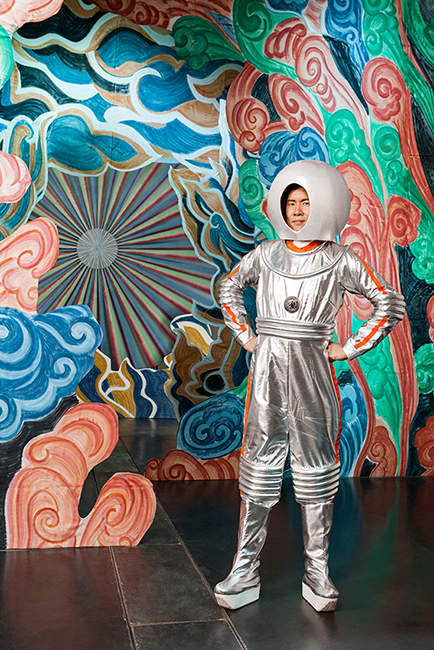
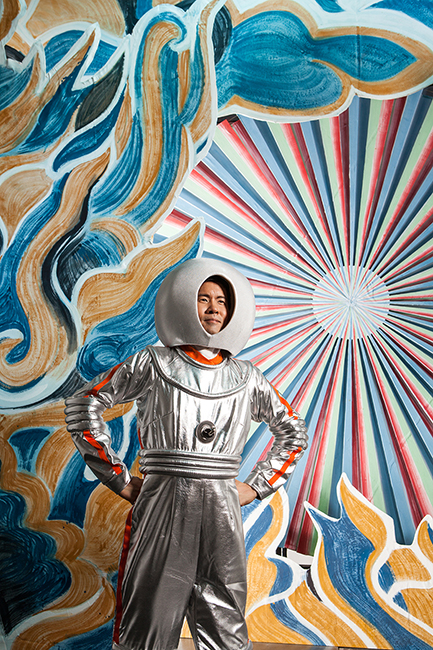
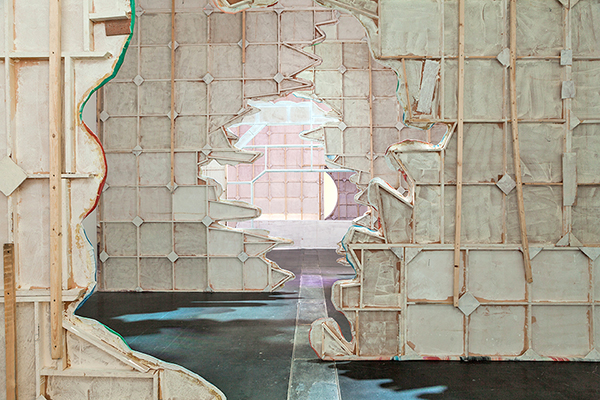
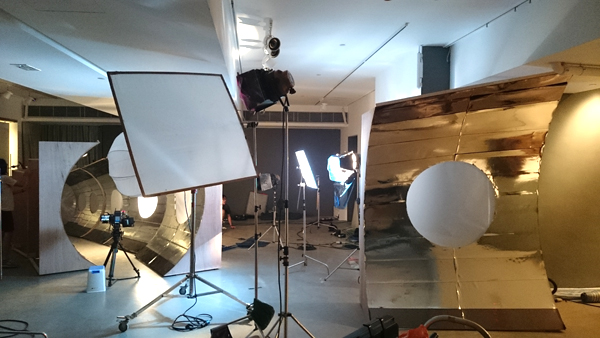
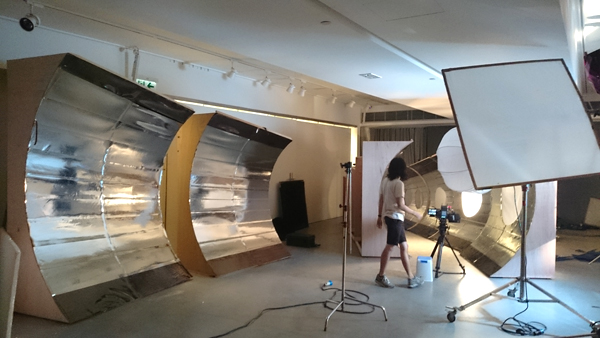
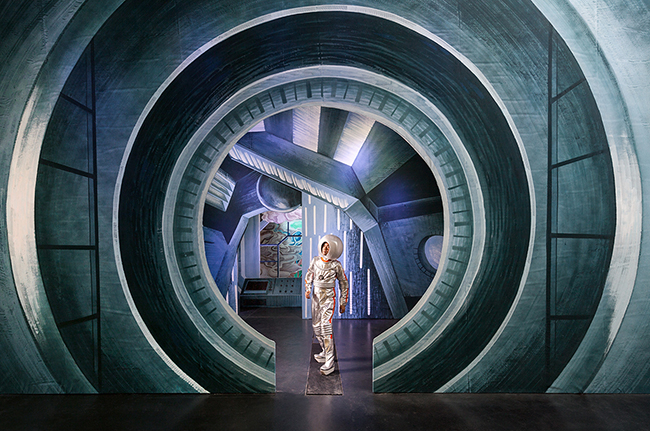
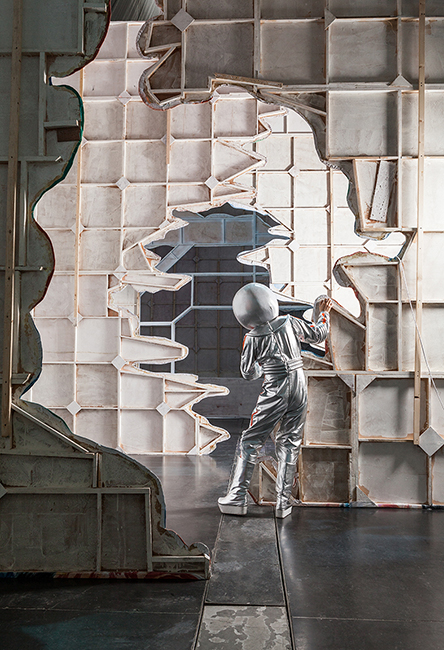
For the installation Scenography for a Chinese Science Fiction Opera, Ming Wong transformed the Nave gallery space at UCCA into a full-scale three-dimensional theatre stage set, constructed out of hand-painted wooden backdrops.
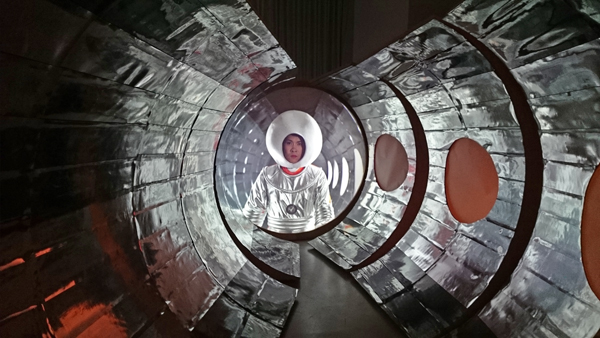
Visitors can walk through the interior of a spaceship – derived from science fiction movies from the Eastern Bloc in the 50s and 60s, and fused with the aesthetics of a Chinese ornamental garden – and then beyond swirls of clouds into outer space – inspired by cosmological design motifs from Chinese opera and ancient religious cave murals – towards the swirling vortex of the universe, symbolized by a kaleidoscopic, disorienting wheel of color.

Ascent To The Heavenly Palace
The diverse iconography in the work represents a multifaceted cultural landscape and a nonlinear timeframe derived from the artist’s recent investigations into various aspects of the modernization of Cantonese opera, including its scenography and cinematic transformations, and its unlikely relationship with the development of science-fiction in China.
In this work, the viewer seems to be walking towards the future yet facing the past, which calls into question the linear, continuous and quantitative aspects of time.

Accompanying the stage set is a series of photographs of the artist as a space explorer within this scenography, entitled “Ascent to the Heavenly Palace (I-IV)”. The costumes, backdrops and poses recall an uncertain nostalgia of chinese propaganda posters, children’s space adventure books and pantomime.

Photographs by Eric Gregory Powell.

Windows On The World (Part 2) / 世界上的窗户(第二部份)

Windows On The World (Part 2)

Windows On The World (Part 2) / 世界上的窗户(第二部份)

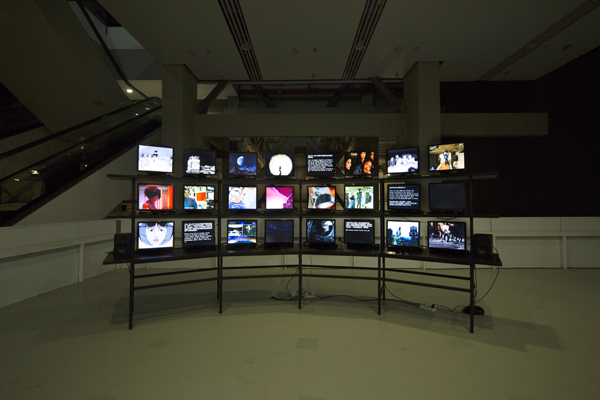
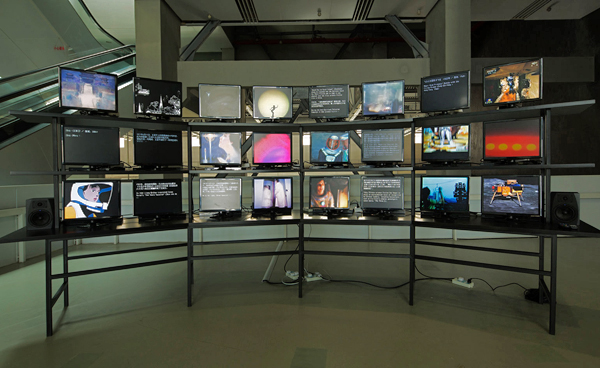
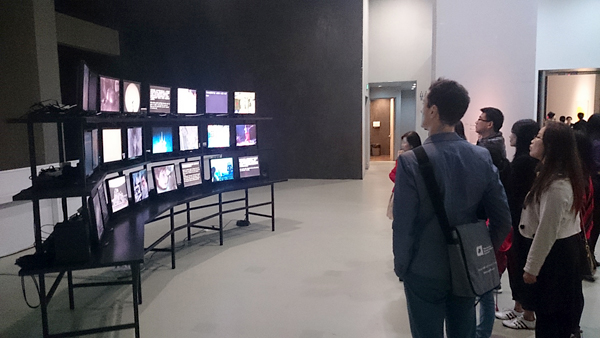
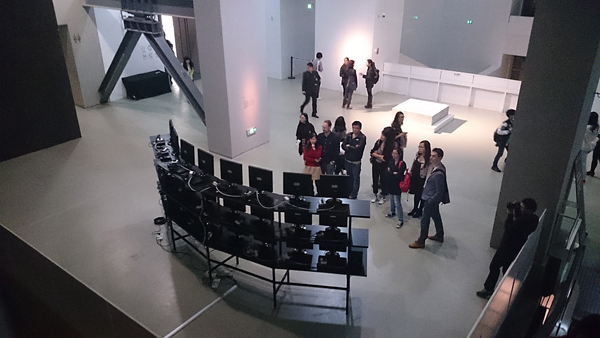
24 channel video installation
2014

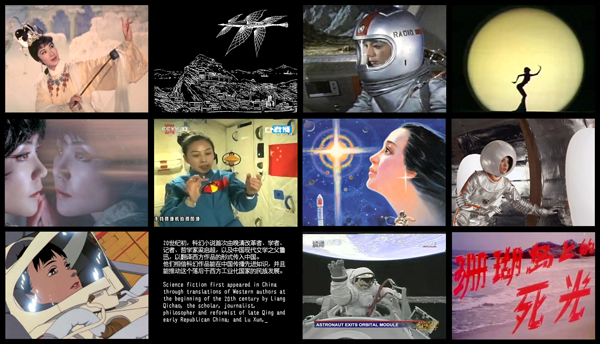
This work focuses on the concept of “future” in Chinese modernity, and particular, how it is manifested in the unlikely relationship between sci-fi and 20th century Cantonese opera.
The former has been at the core of Chinese modern reformation, the latter is viewed more as a potent modern national identifier, than as a continuous art form, surviving from pre-modern times unaltered.
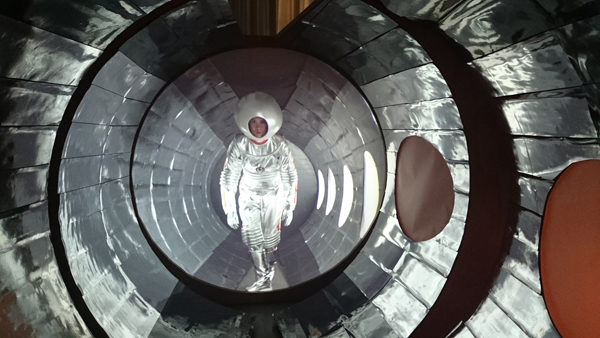
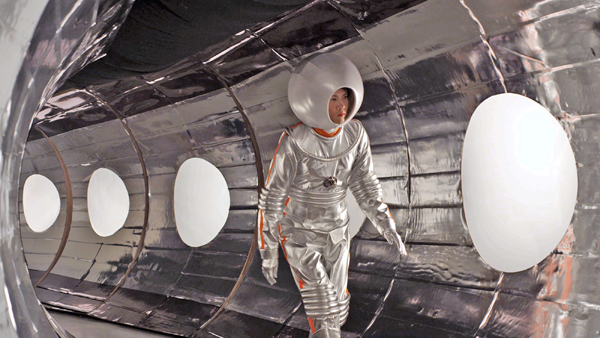
The structure featured as part of the Shanghai Biennale could represent the deck of a space ship in a fictional Chinese sci-fi movie from the 1960s or 1970s.

Windows On The World (Part 2)

Although China’s radical approach to both tradition and to redesigning the future was different from communist countries elsewhere during this time, Wong nonetheless incorporates elements from an icon of 20th century Soviet cinema. Specifically, the artist references Tarkovsky’s Solaris (1972), its oceanic landscape and infinite horizon of islets. The individualist melancholy and alienation of the film are contrasted with a history shaped by the scale and scope of the Cultural Revolution.
(from the exhibition text)

Windows On The World (Part 1) / 世界上的窗户(第一部份)

Windows On The World (Part 1)Windows On The World (Part 1) / 世界上的窗户(第一部份)

in collaboration with Thomas Tsang / DeHow Projects
commissioned by ParaSite Art Space / Spring Workshop for the group exhibition Islands Off the Shores of Asia

mixed media installation featuring a single channel video
2014

As part of the Wong’s long-term endeavor on the unconscious relationships between sci-fi and Cantonese opera, the structure built in the exhibition departs from the oceanic landscape appearing in Tarkovsky’s Solaris (1972) and its infinite horizon of islets. In this work the vortex of space conquest collides with the vortex of antiquity, becoming a site where a Chinese sci-fi plot is imagined.
(from exhibition text)

Singaporean artist Ming Wong’s incredible tunnel installation Windows on the World (2014). As you walk into the Kubrick-esque ‘tunnel’ (fashioned out of wood and fabric), dotted with translucent portholes, the soft strains of Cantonese opera grow louder. At the end of the tunnel, the vanishing point, a looped video is screened of Wong in spacesuit gear, tumbling and arcing through the air to the opera aria Princess ZhaoJun Crosses the Border.
“Science fiction is a space where one can reimagine societies and identities, and extend an idea or the repercussions of that idea, on a society,” says Wong of his creative response to the show title, Islands Off the Shores of Asia. “And the events of [Occupy Central] have called up so many ideas and questions. What is the future of Hong Kong? Utopian or dystopian? Who belongs to Hong Kong? Who does Hong Kong belong to?”
(from TimeOut review by Ysabelle Cheung)

Blast off into the Sinosphere

Blast off into the SinosphereBlast off into the Sinosphere

ongoing research, performance lecture
from 2014

During a residency in Hong Kong from Dec 2013 to Jan 2014, supported by Para Site/Spring Workshop, my research on the history of Cantonese opera cinema led me into the realm of contemporary Chinese science fiction.
At first I studied how Cantonese opera went from stage to screen and how the innovations of cinema have then affected this form’s return from screen to stage.
I was interested in the idea of exploring how one of the oldest performing art forms in the world can be used to address notions of the ‘future’.
What role can Cantonese opera play in a world that continues to evolve at such great speed, when a booming economy and rapid technological developments can cause daily life in China to resemble a classic sci-fi narrative?
This led me to focus on the history and development of science fiction literature and cinema in the Chinese-speaking world, particularly in mainland China.

I gave a performance lecture at Spring Workshop in Jan 2014, presenting my ideas thus far, while I continue on this fantastic voyage between the diverse expressions of the past and the future.